
The Widow’s Might
Today’s gospel, commonly known as the ‘widow’s mite’, is one of the most recognized stories in the Bible. An older woman, a widow, comes to make her donation to the Temple. There are thirteen wooden donation boxes with metal trumpet-shaped tops: nine for taxes and the rest for voluntary donations in the women’s court of the Temple. She arrives and puts in not one but two small copper coins, historically described as the smallest Roman coinage, so this really was an insignificant sum.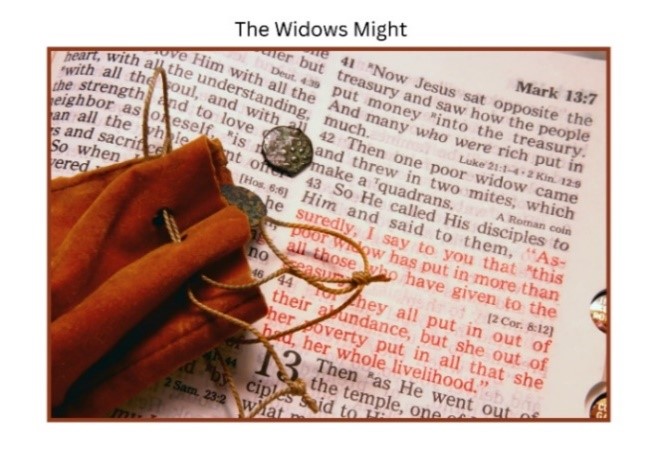
Jesus, who is sitting outside the Temple, opposite this part of the women’s court, is doing more than just ‘watching’ – the original Greek text says he is ‘considering’ or ‘studying’ what he sees. He calls his disciples together, points this woman out to them, and praises her humility and strength of faith. At the same time, his admiration is coupled with strong reservations about what is happening around him. While “many rich people put in large sums,” she put in all she had.
Earlier, he had berated the scribes for ‘contributing out of abundance’ and yet they “devour widows’ houses (buy them) and for the sake of appearance say long prayers.” These religious leaders were meant to be taking care of widows and orphans according to the Law of Moses, yet they are retaking their last penny from them in the Temple. So, the widow’s offering stands in stark contrast.
This gospel is about humility and faith. The word humility comes from the Latin “humus,” meaning earth or soil. To be humble is to be grounded, to be rooted. It’s a virtue that encourages us to be modest and respectful, valuing others equally. The real beauty of humility is that it frees us not only to embrace ourselves but to accept others. In Four Quartets, T S Eliot remarks that “the only wisdom we can hope to acquire is the wisdom of humility: humility is endless.”
Jump ahead to 2024, and we see that hypocrisy and lack of humility continue to thrive globally. Despite the efforts of many who work tirelessly with the poor and champion justice, their noble actions are often overshadowed by rampant materialism and unfair commercial practices. This uphill battle calls for us to be ‘mighty’ in our resolve and actions.
Why was the widow woman mighty? She gave without any hope of exception or return, she was humble enough to embrace the truth about who she was and her relationship with God. Jesus was paying attention to that and pointed to her as the model to his disciples to teach them the root truth of being a Christian then and now. As Ashley Brilliant wisely observes, ‘While we can’t alter the past, every action we take shapes the future.
Jesus always offers us possibilities of looking at things anew. As Christians, the whole thrust of our actions is for reconciliation, not judgment and condemnation. To be Christian is to be truly human. I leave you with one question to ponder:
How can you clear your heart of wants and needs and provide a Sacred Space for God today?
By Sr Susie O’Rawe OP