

Carmel Meade
Twelfth Sunday in Ordinary Time
Sunday 21st of June 2026
Mathew 10: 26-33
This Gospel is part of the instructions Jesus gave to the twelve Apostles when He was preparing them for their Mission. It can also apply to us in our everyday life.
The words “Do not be afraid“ are in the first verse and also in verse 28. Verse 31 states “No need to be afraid.“ It is a comforting and encouraging message.
St. Mathew was primarily writing his Gospel for a Jewish audience, those who were familiar with the messages of the Prophets. Chapter 10: 5 – 6 “Go nowhere among the Gentiles, and enter no Samaritan town, but go rather to the lost sheep of Israel.“ Mathew believed that Jesus was the Messiah and this is the message that he wanted to convey.
The Gospel gives very specific instructions on what the work of their mission will involve. Chapter 10 verse 27 states “What I say to you in the dark, tell in the daylight, what you hear in whispers, proclaim from the house-tops.” The Apostles knew that this would take courage and could involve danger.
The words of Jesus “Do not be afraid” reminds the apostles that earthly threats are temporary and that God is the one who decides our ultimate destiny.
The next section reminds us of God’s love for all Life. Jesus uses a sparrow as an example. The sparrow is native to most of Europe, the Mediterranean basin and large parts of Asia. It is currently believed to be the most widely distributed wild bird. It adapts well to most places where humans live. Because sparrows didn’t cost much and were easy to buy in Galilee, they were not considered to be of much value to all people.
The translation in the Mass missalette refers to “not one falling to the ground without your Father knowing“. Another translation suggests that “lands on the ground” or “hops on the ground“ might be more appropriate.
This leads to the wonderful declaration of God’s abiding love for the Apostles and for us: “There is no need to be afraid; you are worth more than hundreds of sparrows.“
But this Gospel doesn’t end there and I wondered were St. Peter and Judas Iscariot there with the rest of the Apostles when Jesus said: “So if anyone declares himself for me in the presence of men, I will declare myself for him in heaven”. But the one who disowns me in the presence of others, I will disown in the presence of my Father in heaven.“
It surprises me how often Faith related topics crop up in ordinary conversations, it sometimes takes a bit of courage to say that I attend Mass regularly or that I attend a Gospel Reflection group in my local parish. People are often curious to know why I do this and I can honestly say that I always get something out of attending Mass or one of the weekly Gospel Reflection meetings. It might be something the priest said in the homily, or a comment made by another member of the Gospel Reflection group, it could be words in the Readings, Psalm or a beautiful hymn sung by the choir during the Mass or even the words written at the top of the Sunday missalette.
Sometimes, it is just being there at Mass with the people who also usually sit in that part of the Church or being with my friends who come to the Gospel Reflection group. I usually feel a sense of peace and feel more prepared for the week ahead.
The message at the top of next Sunday’s missalette says “Day for Life”. No matter what the trials in this life will be, we are assured of God’s love for us.
St. Matthew tells us: “Do not be afraid.”
This is the message I would like you to hold in your heart and maybe you will think of it every time you see a Sparrow!
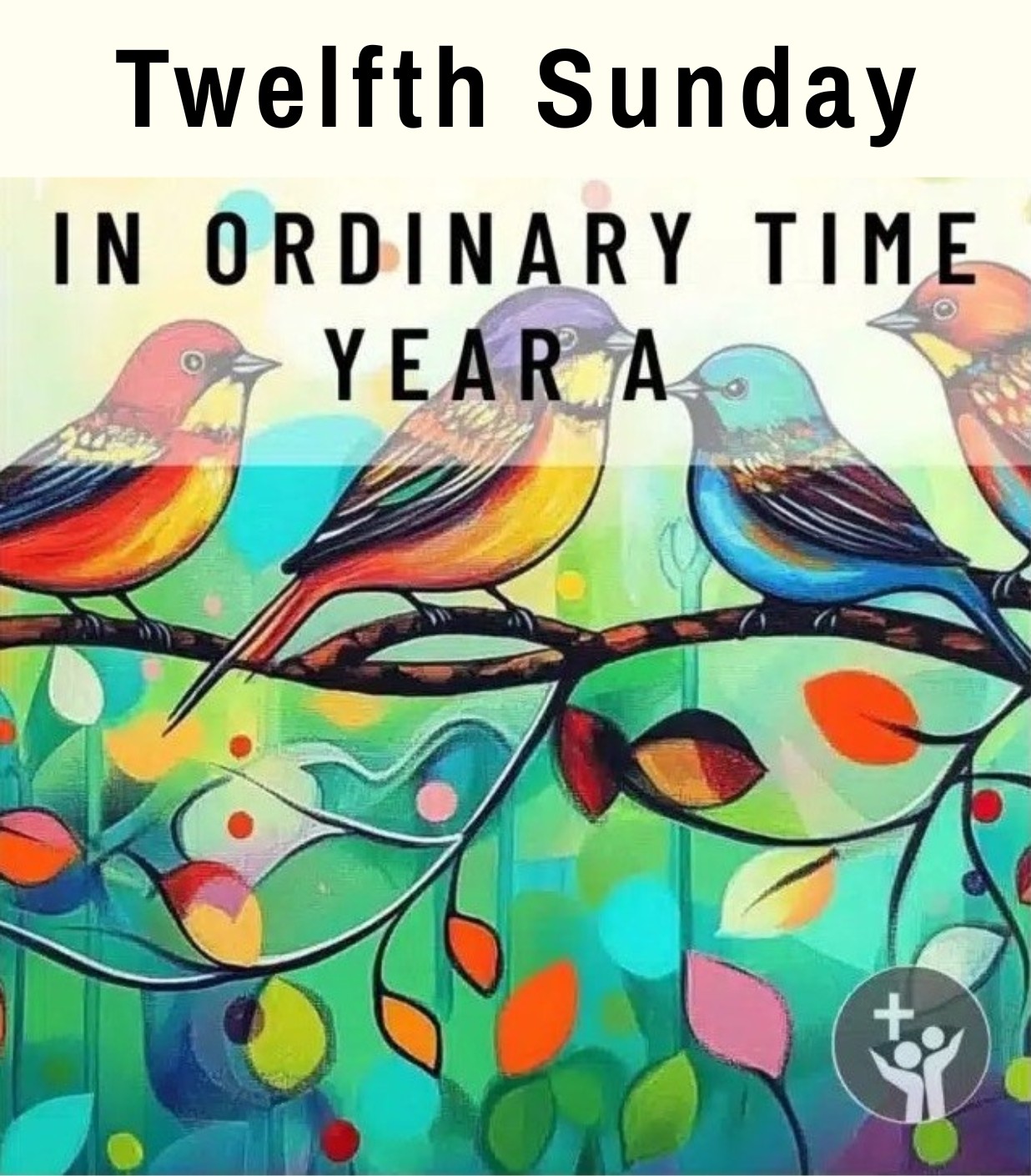
DO NOT BE AFRAID YOU ARE WORTH MORE THAN HUDREDS OF SPARROWS
REFLEXIÓN SOBRE EL EVANGELIO DEL DOMINGO 21 DE JUNIO DE 2026
Mateo 10, 26-33
Este Evangelio forma parte de las instrucciones que Jesús dio a los doce apóstoles cuando los preparaba para su misión. También puede aplicarse a nosotros en nuestra vida cotidiana.
Las palabras «No temáis» aparecen en el primer versículo y también en el versículo 28. El versículo 31 dice: «No hay que temer». Es un mensaje reconfortante y alentador.
San Mateo escribió su Evangelio principalmente para un público judío, familiarizado con los mensajes de los profetas. Capítulo 10, versículos 5-6: «No vayáis a los gentiles, ni entréis en ninguna ciudad de los samaritanos, sino id más bien a las ovejas perdidas de Israel». Mateo creía que Jesús era el Mesías y este es el mensaje que quería transmitir.
El Evangelio da instrucciones muy específicas sobre en qué consistirá la labor de la Misión. El capítulo 10, versículo 27, dice: «Lo que os digo en la oscuridad, decidlo a la luz del día; lo que oís al oído, proclamadlo desde los tejados». Los apóstoles sabían que esto requeriría valor y podría entrañar peligro.
La siguiente sección nos recuerda el amor de Dios por toda la vida. Jesús utiliza el gorrión como ejemplo. El gorrión es autóctono de la mayor parte de Europa, la cuenca mediterránea y gran parte de Asia. Actualmente se cree que es el ave silvestre con mayor área de distribución. Se adapta bien a la mayoría de los lugares donde vive el ser humano. Como los gorriones no costaban mucho y eran fáciles de comprar en Galilea, la gente no les daba mucho valor.
La traducción del Misal de la Misa se refiere a «ni uno solo cae al suelo sin que vuestro Padre lo sepa». Otra traducción sugiere que «aterriza en el suelo» o «salta al suelo» podría ser más apropiado. Esto nos lleva a la maravillosa declaración del amor inquebrantable de Dios hacia los apóstoles… y hacia nosotros: «No temáis; vosotros valéis más que cientos de gorriones».
Pero este Evangelio no termina ahí… y me preguntaba si San Pedro y San Judas Iscariote estaban allí con el resto de los apóstoles, escuchando lo que Jesús dijo en el versículo 32: «Así que, si alguien se declara a favor mío ante los hombres, yo me declararé a favor suyo en el cielo. Pero al que me niegue ante otros y otras, yo lo negaré ante mi Padre que está en los cielos».
A menudo me sorprende la frecuencia con la que surgen temas relacionados con la fe en las conversaciones cotidianas; a veces hace falta un poco de valor para decir que voy a misa con regularidad o que asisto a un grupo de reflexión sobre el Evangelio en mi parroquia. La gente suele sentir curiosidad por saber por qué lo hago y puedo decir con toda sinceridad que siempre saco algo en claro de asistir a misa o a una de las reuniones semanales de reflexión sobre el Evangelio. Puede ser algo que haya dicho el sacerdote en la homilía, o un comentario de otro miembro del grupo de reflexión sobre el Evangelio; pueden ser palabras de las lecturas, del salmo o de un hermoso himno cantado por el coro durante la misa, o incluso las palabras escritas en la parte superior del misal dominical. A veces basta con estar allí, en la misa, con las personas que también suelen sentarse en esa parte de la iglesia. O estar con mis amigos que acuden a la reunión de reflexión sobre el Evangelio. Normalmente siento una sensación de paz y me siento más preparada para la semana que tengo por delante.
El mensaje que encabeza el folleto de la misa del próximo domingo es «Día por la Vida». Dios está siempre con nosotros,conoce cada uno de nuestros pensamientos, palabras y acciones. Nos ama y cuida de nosotros constantemente. Nos mira y nos dice: «No temáis».
Y ese es el mensaje que me gustaría que guardaras en tu corazón y quizá pienses en él cada vez que veas un gorrión.

NO TENGAS MIEDO: VALES MÁS QUE CIENTOS DE GORRIONES.