
The Feast of Corpus Christi
The feast of Corpus Christi left a deep impression on me from my early childhood.
It was very much a community feast; every family prepared for it, particularly those who lived along the route of the procession, decorating the outside with flowers and often placing an altar at the entrance to their homes.
As children we had a very special role in the Corpus Christi procession. My aunt Alice who had a beautiful rose garden supplied all of us with rose petals for our little baskets; the perfume of which filled the air. Our task was to strew the petals before the blessed sacrament as we made our way to the Cathedral to a solemn liturgy with no shortage of incense.
Looking back on that experience, for us as young children, it left us with a deep sense of the sacred and indeed something of the experience of pilgrimage, as it always seemed a very long walk to the Cathedral!
Many years later in Latin America my understanding of Eucharist was deepened, challenged and enriched in a way which could be summed up in a quotation from the recently deceased and much loved Dominican Fr. Gustavo Gutierreez:
“The Eucharist is not a merely private, other worldly ritual, it is the ultimate expression of God’s gratuitous love and a radical call to solidarity, justice and active participation in the liberation of the oppressed”

In the first reading of this Sunday we find the Jewish people celebrating the feast of of Passover. Moses offers his people two invitations; One is to “remember” and the other is: “not to forget.” He invites the community to remember ‘the wilderness, remember your hunger, remember the food; the manna provided for you. Remember all that God has done for you.
Do not forget God’s gift of liberation from slavery.
Are there moments of reflection in my life when I sense God calling me to remember and others where I am called not to forget?
The only response to that first reading had to be a prayer of praise and thanksgiving for all God had done.
Reading the two verses of St Paul’s letter to the Corinthians 10:16-17 could be summed up in four words; – One bread, One body.
The celebration of Corpus Christi reminds us again that all who are nourished by the body and blood of Christ do so to become one, not only with Jesus, but with each other, with all people and the whole community of creation.
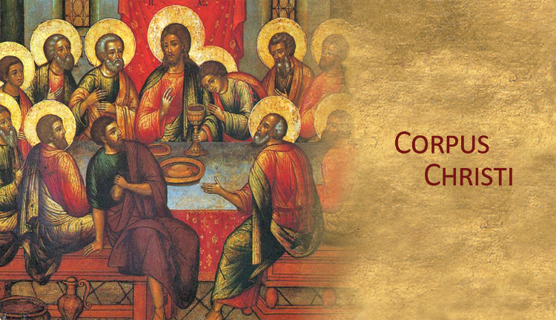
One the most striking features of the Gospel of John as presented to us on this Sunday: is John’s use of the word life. In the translation I am using it is used eleven times in different forms. The first sentence begins with the following powerful statement made by Jesus himself, “I am the living bread.”
Jesus is our living bread, nourishing us, strengthening us, teaching us, giving us life. “You who eat my flesh and drink my blood live in me and I live in you.”
What a gift! What a promise!
The final words of this Sunday’s Gospel are charged with hope; life doesn’t end with our physical death, because Jesus gave us this promise:
“Anyone who eats this bread will live forever”
Let us remember and not forget this gift of Jesus calls us outward.
As a Eucharistic people we are called to be the bread of life for others; living self-giving lives for those who hunger and long for food, for peace, justice and ‘right relationships between God, people and the earth.
By Caitríona Gorman
La fiesta del Corpus Christi
La fiesta del Corpus Christi me causó una profunda impresión desde mi más tierna infancia.
Era una fiesta muy comunitaria; todas las familias se preparaban para ella, sobre todo aquellas que vivían a lo largo del recorrido de la procesión, decorando el exterior con flores y, a menudo, colocando un altar a la entrada de sus casas.
De niños teníamos un papel muy especial en la procesión del Corpus Christi. Mi tía Alice, que tenía un hermoso jardín de rosas, nos proporcionaba a todos pétalos de rosa para nuestras pequeñas canastas; cuyo perfume llenaba el aire. Nuestra tarea consistía en esparcir los pétalos ante el Santísimo Sacramento mientras nos dirigíamos a la catedral para una liturgia solemne en la que no faltaba el incienso.
Al recordar esa experiencia, para nosotros, como niños pequeños, nos dejó un profundo sentido de lo sagrado y, de hecho, algo de la experiencia de la peregrinación, ¡ya que siempre parecía un camino muy largo hasta la catedral!
Muchos años después, en América Latina, mi comprensión de la Eucaristía se profundizó, fue desafiada y enriquecida de una manera que podría resumirse en una cita del recientemente fallecido y muy querido dominico P. Gustavo Gutiérrez:
«La Eucaristía no es un ritual meramente privado y de otro mundo, es la máxima expresión del amor gratuito de Dios y una llamada radical a la solidaridad, la justicia y la participación activa en la liberación de los oprimidos»
En la primera lectura de este domingo encontramos al pueblo judío celebrando la fiesta de la Pascua. Moisés ofrece a su pueblo dos invitaciones; una es «recordar» y la otra es: «no olvidar». Invita a la comunidad a recordar «el desierto, recordar el hambre, recordar el alimento; el maná que se les proporcionó. Recordar todo lo que Dios ha hecho por ustedes.
No olviden el don de Dios de la liberación de la esclavitud.
¿Hay momentos de reflexión en mi vida en los que siento que Dios me llama a recordar y otros en los que se me llama a no olvidar?
La única respuesta a esa primera lectura tenía que ser una oración de alabanza y acción de gracias por todo lo que Dios había hecho.
La lectura de los dos versículos de la carta de San Pablo a los Corintios 10,16-17 podría resumirse en cuatro palabras: un solo pan, un solo cuerpo.
La celebración del Corpus Christi nos recuerda una vez más que todos los que se alimentan del cuerpo y la sangre de Cristo lo hacen para llegar a ser uno, no solo con Jesús, sino entre nosotros, con todas las personas y con toda la comunidad de la creación.
Una de las características más llamativas del Evangelio de Juan, tal como se nos presenta este domingo, es el uso que hace Juan de la palabra «vida». En la traducción que estoy utilizando, aparece once veces en diferentes formas. La primera frase comienza con la siguiente poderosa declaración hecha por el mismo Jesús: «Yo soy el pan vivo».
Jesús es nuestro pan vivo, que nos nutre, nos fortalece, nos enseña y nos da vida. «El que come mi carne y bebe mi sangre permanece en mí y yo en él».
¡Qué regalo! ¡Qué promesa!
Las palabras finales del Evangelio de este domingo están cargadas de esperanza; la vida no termina con nuestra muerte física, porque Jesús nos hizo esta promesa:
«El que coma este pan vivirá para siempre».
Recordemos y no olvidemos que este regalo de Jesús nos llama a salir.
Como pueblo eucarístico, estamos llamados a ser el pan de vida para los demás; a vivir una vida de entrega a quienes tienen hambre y anhelan alimento, paz, justicia y «relaciones correctas entre Dios, las personas y la tierra».
Por Caitríona Gorman